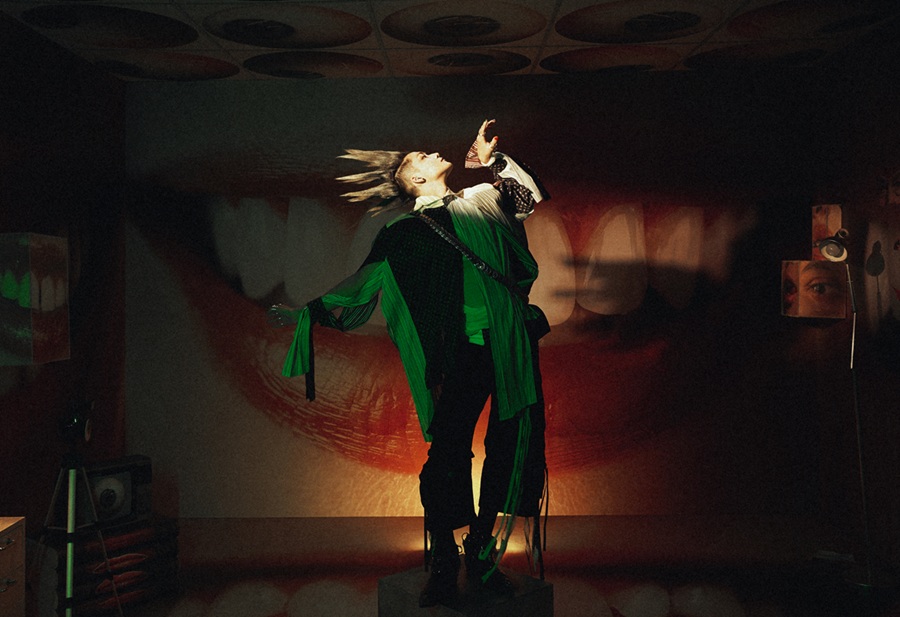
Oji-Cree singer-songwriter Aysanabee wrote the title track on his new album Edge of the Earth while he was touring Italy. The two-time Juno winner was strolling along beautiful, tiled walkways in the southeastern city of Barletta, watching merchants setting up fruit stands as old men sipped on their espresso.
“I took a seat on this grassy knoll,” Aysanabee tells the Toronto Spark over Zoom. “There just happened to be a castle there because there are castles everywhere on that continent. And the bells started ringing.
“For the first time in my life, it felt like I was on a path, going to a place I want to go to,” he continues. “Whereas before, I always kind of felt like I was in this fight-or-flight mode.”
Aysanabee points out that Edge of the Earth differs from his first two albums in key respects. His successful debut, Watin, was a concept album. It integrated his grandfather’s voice into a collection of songs chronicling Indigenous life in Canada.
The musician describes his follow-up EP, Here and Now, as a “break-up album”.
Edge of the Earth, on the other hand, offers Aysanabee’s perspectives about experiences on various aspects of his life over the past two-and-a-half years. And it comes in a lush and richly textured musical soundscape.
“If I am being completely honest, I found it quite difficult to market this record because it was just kind of my own moments…that have brought me to—in certain cases—crossroads in my life,” Aysanabee says.
Watch the video (above) for “Without You”.
Aysanabee performs on a frozen lake
One of the songs, “Without You”, is a mournful song of grief for his grandfather. The music video features Aysanabee singing on frozen Whitefish Lake in Ontario’s Thunder Bay District. It carries special significance because his uncle—also his grandfather’s son—fell through the ice on a snowmobile and perished.
“My grandfather never went skidooing ever again—and he loved skidooing,” Aysanabee says.
He is a member of the Sucker Clan of the Sandy Lake First Nation, which is a fly-in community in northwestern Ontario. For him, shooting the video on an icy lake subtly demonstrates that it’s possible to break cycles of trauma.
Aysanabee co-wrote another Edge of the Earth song, “Home”, with his longtime friend La La Noel and Scott McCannell. Noel performs backup vocals on “Home”, which is bluesy, upbeat, and full of rhythm.
“That is a song about letting go of things that don’t serve you,” Aysanabee says. “I think the fact that we were going through the same thing only made that song more beautiful in that respect.”
Yet another newer composition, the soaring “Dream Catcher”, is an aspirational song about pursuing one’s goals while remaining authentic to oneself.
Watch Aysanabee and other band members perform “Home”.
The Way We’re Born Tour comes to B.C.
As a former journalist, Aysanabee still keeps up with the news, whether it’s in Canada or in Palestine. He hasn’t lost sight that what’s happening in the world is vitally important.
“But part of me is, ‘Like, you know what? It’s still important to create art, create moments, and tell stories.’ ”
Aysanabee is taking his The Way We’re Born Tour to many Canadian communities in support of Edge of the Earth. He will play the Capital Music Club in Saskatoon on Saturday (November 22), the Exchange in Regina on Monday (November 24), and the Park Theatre in Winnipeg on Tuesday (November 25). That will be followed by gigs in six gigs in Ontario—Ridgeway (November 28), Orillia (November 29), Windsor (December 5), Walkerton (December 6), Hamilton (December 7), and Kingston (December 11). Then it’s off to Gatineau, Quebec (December 12) before a performance in Thuder Bay on December 14).
“I’m really excited to perform these songs—and perform songs from all the records—because none of the records have had their own headline tour before,” Aysanabee says.
An Indigenous artist will be the opening act at each show.
Last year, he won the Juno Award as Songwriter of the Year for gut-wrenchingly emotional songs like “Alone”, “Here and Now”, and “Somebody Else”. He also captured a second Juno last year for Alternative Album of the Year—the first time an Indigenous artist had won both those awards in the same year.
Aysanabee admits that he initially wasn’t sure what it meant to be nominated for being “alternative”.
“But I’ve grown to really love that category because it’s kind of a catch-all,” he says. “So, it feels like I’m less pigeonholed. It gives me more freedom to explore and evolve and keep creating different kinds of music.”
Watch Aysanabee perform “Dream Catcher”.
Learn more about Aysanabee and buy tickets to his concerts by visiting his website. Learn more about the communities that make up Canada on the Toronto Spark website. The Toronto Spark is on Bluesky @torontospark.bsky.social.