By Wanjara Nomad Collections
Public controversies are often dismissed as disagreements over nomenclature. That is a mistake. The issue before British Columbia is not whether one phrase is more familiar than another, nor whether a government may refine its records. It is whether a Province may formally recognize a fuller historical truth and then withdraw that recognition without explanation, notice, or consultation. This is not semantics. It is a question of public record, democratic integrity, and the ethics of memory.
The documentary sequence is clear.
On November 21, 2025, British Columbia issued a formal proclamation designating May 23, 2026 as “Guru Nanak Jahaz (Komagata Maru) Remembrance Day”. In doing so, the Province acknowledged that the passengers arrived aboard the Guru Nanak Jahaz, a vessel chartered for $66,000 by the Guru Nanak Steamship Company. For the first time in British Columbia’s provincial record, through a Royal Proclamation, the name used by the passengers themselves was formally recognized.
The signature of the Crown on a Royal Proclamation is intended to confer permanence, not function as a temporary entry in a political ledger.
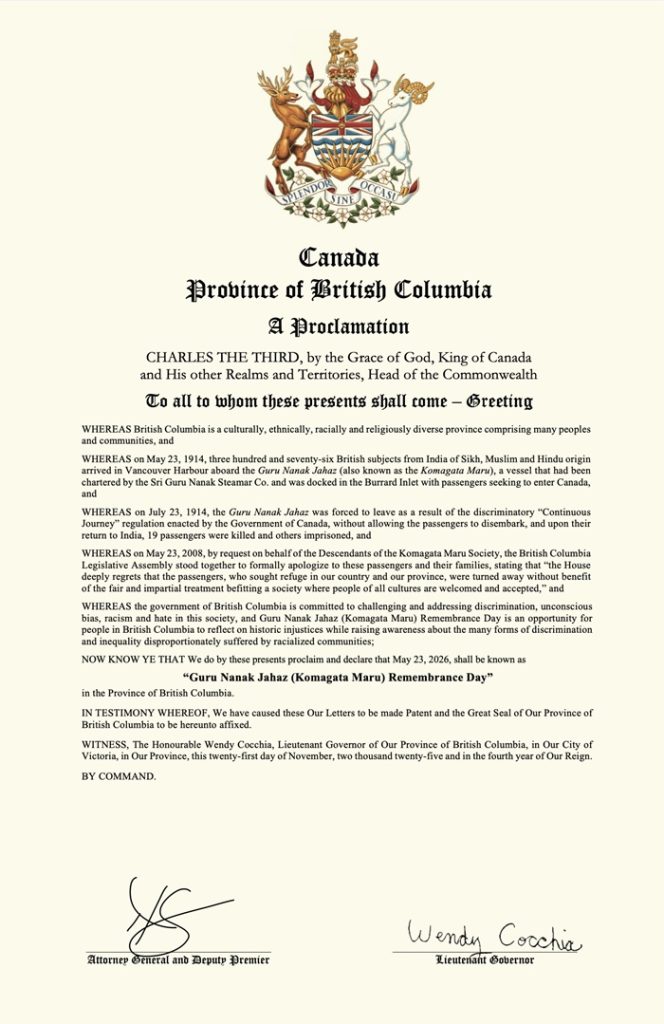
Province reverses Guru Nanak Jahaz designation
On January 9, 2026, that proclamation was rescinded. A second instrument redesignated the day as “Komagata Maru Remembrance Day”, removing Guru Nanak Jahaz from the title entirely. This was not interpretive drift. It was a formal reversal recorded in the Province’s own registry—an act of public authority that restores the colonial designation as the sole public title.
The removal of “Guru Nanak Jahaz” suggests that, when faced with a choice, the Province reverted to the better-known colonial designation rather than the historically grounded name it had already recognized. The Province had already adopted a workable formulation in November, pairing both names. The subsequent removal of “Guru Nanak Jahaz” was therefore not a matter of necessity. It was a matter of choice.
For those aboard, the vessel functioned as a floating Gurdwara Sahib during the Pacific voyage, marked by the presence of the Guru Granth Sahib ji, the Nishan Sahib, and the observance of sangat, langar, and pangat. It was a Sikh-led undertaking that brought together 377 passengers—all of them Panjabi, including Sikhs, Muslims, and Hindus—in a shared challenge to the discriminatory Continuous Journey Regulation. The voyage was not merely a migration attempt, but a deliberate act of legal, moral, and spiritual resistance.
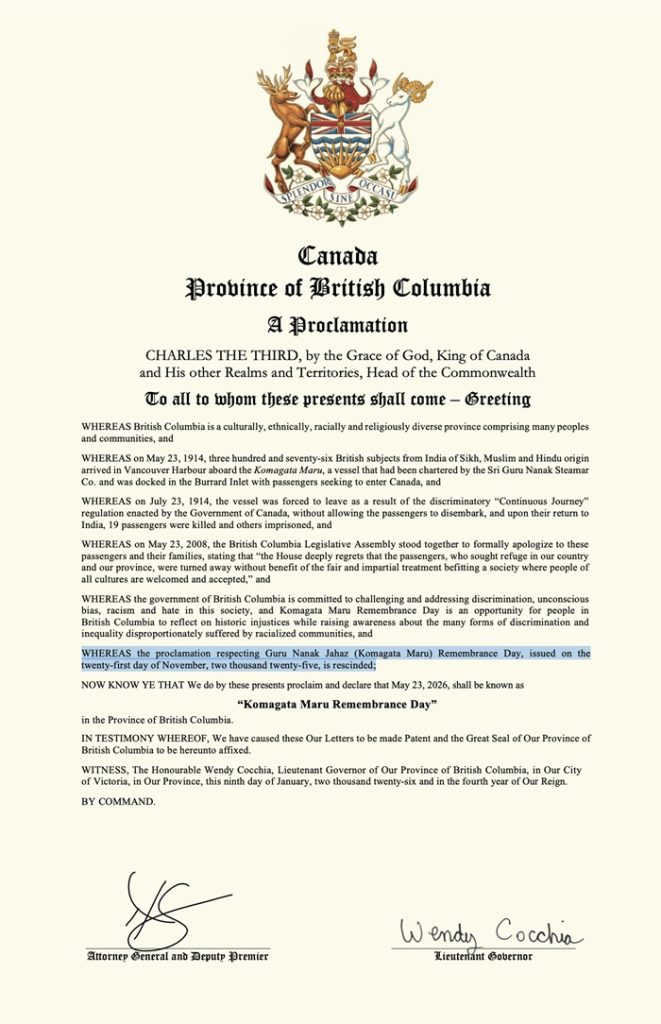
Government at odds with cities and museums
Removing “Guru Nanak Jahaz” is not a neutral editorial act. It privileges an external commercial designation over the name, faith, and lived reality of the passengers themselves.
Nor is this interpretation novel. Municipal and cultural institutions across British Columbia have already aligned their records accordingly. The City of Vancouver has restored the name in its civic naming, and the City of Surrey has adopted it in official recognition. Cultural institutions, including the Museum of Vancouver and the Sikh Heritage Museum, have incorporated “Guru Nanak Jahaz” into their interpretive work.
Recognition of the name is therefore grounded in established institutional practice. The Canadian Encyclopedia likewise uses the formulation “Komagata Maru (Guru Nanak Jahaz)” and notes both that the passengers renamed the vessel Guru Nanak Jahaz and that the memory of that name endured especially among Punjabi Canadians. Recognition of the name is therefore not marginal or improvised. It is grounded in an established and widening interpretive record.
Equally significant is the manner of the reversal. No public notice accompanied it, and no explanation was issued. The reversal remained undisclosed until Wanjara Nomad Collections identified it through an independent review of the Province’s own registry. Public trust is not weakened by disagreement, but by silence. The integrity of the public record is foundational to a transparent democracy. British Columbia must now decide whether it will honour the history it has already acknowledged, or permit the bureaucracy of memory to erase that agency by administrative means.
That silence raises a further question.
The question that now arises is fundamental to administrative authority: was the rescission the result of standard internal review, or a concession to external pressure? The public registry acts as a black box, offering no indication of whether diplomatic or other outside input dictated the decision. This is especially true where the passengers themselves understood the voyage as that of the Guru Nanak Jahaz and carried it in a spirit of Chardi Kala, resilient optimism in the face of exclusion.
The issue is not only historical. It is legal.
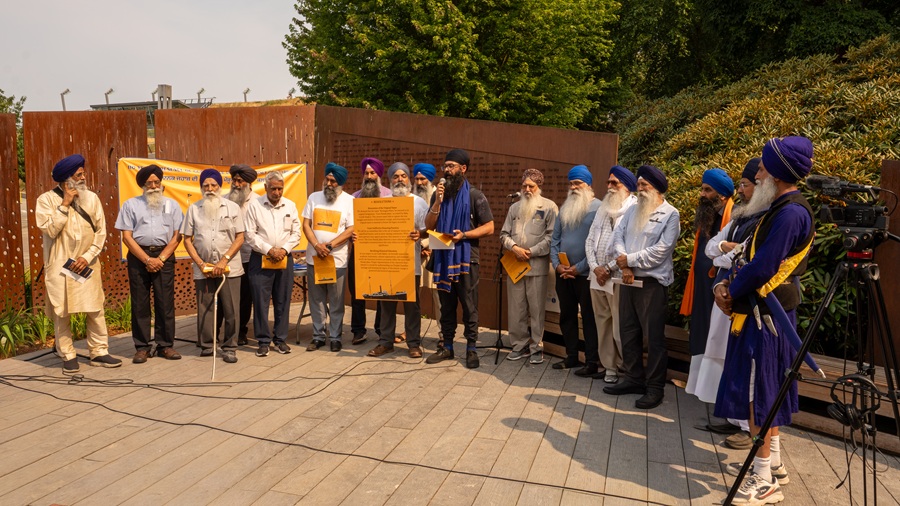
B.C. open to restoring Guru Nanak Jahaz name
The November proclamation constituted a clear public representation upon which the community could reasonably rely. In Canadian administrative law, such representations give rise to legitimate expectations of procedural fairness, as affirmed in Baker v Canada. The reference to principles of administrative fairness is not to suggest that a commemorative proclamation creates individual legal rights, but to situate the expectation that public representations by the state are accompanied by transparency, consistency, and reasoned explanation.
The rescission of that representation without notice, explanation, or opportunity to be heard raises serious questions as to whether those principles were observed. It also invites scrutiny in light of Section 15 and Section 2(a) of the Canadian Charter of Rights and Freedoms.
Following formal correspondence, the Province has initiated engagement and indicated an openness to restoring the name through consultation. It has also been indicated that provincial proclamations fall within provincial jurisdiction and are not contingent upon any federal position. These statements have been placed on record and remain subject to confirmation. If affirmed, they would establish that responsibility for addressing the discrepancy in the public record rests with the Province.
History cannot be honoured in November and quietly revised in January without explanation.
The Province must now account for its own record: who authorized the rescission, on what basis, and through what process. It must also clarify whether the decision arose solely from internal administrative review or whether external or diplomatic considerations—directly or through intermediary channels—played any role. If considerations beyond the public record shaped this decision, they must be brought into the light. The dignity of the passengers is not a matter for quiet negotiation.
These are not speculative inquiries. They are the minimum requirements of transparent and accountable governance.
The issue is no longer whether Guru Nanak Jahaz merits recognition. British Columbia has already acknowledged that historical truth. The question now is whether the Province will restore that truth to the official proclamation and account for the decision to remove it. By reinstating the name “Guru Nanak Jahaz”, the Province can correct the public record and align its commemoration with the lived reality and agency of the passengers.
Wanjara Nomad Collections is a British Columbia–based research organization dedicated to preserving rare primary source materials relating to Sikh history, presence, and memory. Its broader work to preserve, learn, and share includes I Am Not South Asian. For more information on the Wanjara Nomad Collections Team, visit its website.
The Toronto Spark is on Bluesky @torontospark.bsky.social.