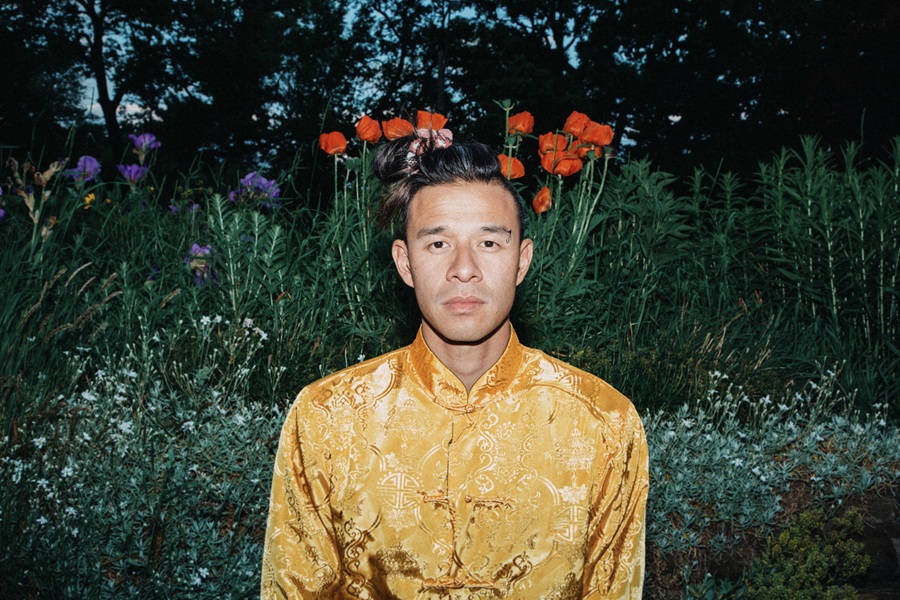
Sean Dulake’s career path as an actor, producer, and director coincided with an extraordinary development in the history of show business. For the past 15 years, the California native has lived much of his life in South Korea. There, Dulake has witnessed and documented how an Asian country of just 50 million people morphed into a global entertainment juggernaut.
He has acted in well over a dozen movies and TV series in South Korea, including alongside Liam Neeson in Battle for Incheon: Operation Chromite. In addition, Dulake was executive producer of Dramaworld, an English-Korean fantasy romantic comedy that ran from 2016 to 2021. He also had a lead role in the series, which was broadcast on Netflix.
“That show was very definitive for me,” Dulake tells Pancouver. “It came out at a time when Korean entertainment was really starting to break out globally.”
Dulake is CEO of Third Culture Content. He founded the company because he wanted to create a show in which he could star. As someone of mixed Korean and British ancestry, Dulake didn’t see any production companies addressing the so-called “third culture”. This term describes people who spent their formative years in a culture different from that of their parents.
Dramaworld revolved around an American girl (Liv Hewson) who’s fascinated by Korean dramas.
“She gets magically transported into her favourite Korean drama through her smartphone,” Dulake says. “It was this very quirky, quite meta, fantasy rom-com that was about 60 to 70 percent in English and then 30 to 40 percent in Korean.”
Sean Dulake and Liv Hewson speak about Dramaworld back in 2016.
Dulake chronicles Korean star system
Dulake will share insights from his experiences at the East by Northwest (EXNW) summit, which takes place in Vancouver from Friday (July 18) through Sunday (July 20). On the first day, he’s one of 10 entertainment executives who will field private pitches from conference participants. Then on Saturday, he will be on an EXNW panel entitled “Own the Spotlight: Building a Canadian Star System for Racialized Talent”.
“There’s definitely a star-making system in Korea, especially on the music side,” Dulake says.
In fact, he chronicled how this star system works in his 2012 documentary, Korea Next: Finding Hallyuwood, which aired on the Discovery Channel. As he looked at the industry from an “insider-outsider” perspective, he had a straightforward question.
“What is it about Korean entertainment that is connecting with global audiences?” Dulake asks. “I just called a lot of my friends—actors, directors—hearing it from the point of view of the actual creators themselves. We cover music, TV, and film.”
Hallyu, a.k.a. the Korean Wave, is a word that originated in China to describe the explosive growth of South Korean popular culture in other countries. As Dulake was editing his film, a chubby-faced Korean singer, songwriter, and producer named PSY released the video for “Gangnam Style”. It was a global phenomenon, racking up billions of views.
“I’m like, ‘Hold on! This, I think, needs to be a part of the doc now,’ ” Dulake relates. “So, of course, we incorporated it.”
The 23-minute film is prescient, anticipating what the Korean entertainment industry needed to do to remain relevant.
“You can draw a direct, linear line to BTS, Blackpink, and what we’re seeing now,” he says. “The seeds were being planted.”
Watch Sean Dulake’s prescient 2012 documentary, Korea Next: Finding Hallyuwood.
Teaching and studying in South Korea
Dulake grew up in Arcadia, which is 21 kilometres northeast of downtown Los Angeles. His mother was born in Seoul and his father was born in London. They met on a blind date.
“Two immigrant parents from different parts of the world came together,” Dulake states.
He and his sister were raised in a traditional American suburb with proms, homecomings, and U.S. football. His sister pursued a career in medicine, whereas Dulake set his sights on entertainment. After studying acting at Boston University and playing a four-year-long character in the Boston University student-produced TV series Bay State, he headed to South Korea..
“I didn’t speak Korean growing up,” Dulake reveals. “So I gave myself two years—to go to Korea, teach English in my first year, like a lot of people do, to pay my way. And go to Seoul National University’s language school.”
For the first year-and-a-half in South Korea, he studied Korean from 9 a.m. to 1 p.m. Then from 3 p.m. to 10 p.m., he taught English to Korean students. As he approached his second anniversary in Korea in 2010, Dulake auditioned for a TV series. He landed the role in a highly rated historical medical drama, Jejoongwon. Dulake played Dr. Allen, an American missionary doctor who established the first western hospital in Korea in the 1880s.
“That was the life-changing moment for me.”
In 2010 and 2011, he acted in a TV series called Athena: Goddess of War, which he likens to a Korean version of 24. Dulake recalls doing arena tours with the cast and K-pop stars, where tens of thousands of people would show up. He came away from this experience so impressed by how Korean entertainers interact with their fans.
“It’s quite phenomenal,” Dulake says. “You see it the most with BTS. They were really grassroots-focused—on the fan base and social media—because they had to complete with the big labels. And look how far they have come.”
Dulake’s newest show is Butterfly, which is billed as a spy action thriller on IMDb It’s his first U.S. series and it will be released on Amazon Prime on August 13.
Watch the trailer for Butterfly.
Dulake works with Liam Neeson
According to Dulake, Japan was a major market for K-pop stars in the early days of the Hallyu explosion. Meanwhile, Korean dramas were popular in Southeast Asia. Then in the mid-2010s, audiences grew enormously in China and then extended to other countries.
Dulake crossed paths with Liam Neeson because the Battle for Incheon: Operation Chromite was produced by Taewon Entertainment, the same company that produced Athena: Goddess of War. Neeson played Gen. Douglas MacArthur. Initially, Dulake was one of the screenwriters for the English script in the film.
“That was in the early days of international co-production,” Dulake says. “But we got an English script to Liam’s people and then he signed on.”
Dulake ended up being cast as Edward L. Rowny, a U.S. Army lieutenant-colonel. Dulake will never forget shooting a scene with Neeson, who was speaking lines that Dulake had written. After one take, Neeson asked Dulake if his acting reflected the writers’ intentions.
“He was just so present and calm—it wasn’t the ‘star’ Liam Neeson,” Dulake emphasizes. “He was so respectful, in fact, that there were two co-writers in the room with him and that we had put this scene together.”
This year, Dulake and Third Culture Content co-founder Janice Chua have been working with the South Korean studio SLL and the Racial Equity Screen Office (RESO) on the Canada-Asia Pacific Production Accelerator (CAPCA). They’ve mentored Canadian producers and writers, who travelled to South Korea as part of the 12-week program. Participants will present their projects at EXNW.
SLL and RESO launched CAPCA as the industry is addressing the rise of artificial intelligence and dealing with fallout from Hollywood labour disputes.
“There is a contraction that’s happening in the U.S. and also in Korea, to some extent, when it comes to projects being greenlit,” Dulake comments. “The conversation was constantly challenging the question of how we create new models around international co-production. Our guess is that the way things will have to be made moving forward will probably be about pooling the resources and talent from multiple countries together to achieve these levels of scale.”
The Racial Equity Screen Office presents East by Northwest (EXNW) from Friday (July 18) to Sunday (July 20). Learn more about the communities that make up Canada on the Toronto Spark website. Find the Toronto Spark on Bluesky @torontospark.bsky.social.