U.S. president-elect Donald Trump recently triggered an avalanche of commentary about Canadian trade relations. This followed his threat to impose a 25-percent tariff on all imported products from Canada and Mexico.
“This Tariff will remain in effect until such time as Drugs, in particular Fentanyl, and all Illegal Aliens stop this Invasion of our Country!” Trump declared over Truth Social.
That had some Canadian officials talking about improving relations with major trading partners across the Pacific Ocean.
“The interest in British Columbia commodities in Asia is very, very high,” B.C. finance Minister Brenda Bailey told CBC Radio One’s On the Coast program.
But in the midst of all the media coverage, there’s been very little discussion of Canada’s trade deficit in cultural goods and services.
One exception is a Substack post by Hill Strategies founder and president Kelly Hill. Relying on Statistics Canada data, the Hamilton-based arts-policy researcher pointed out that Canada exported cultural goods and services worth $24.5 billion in 2022. In the same year, Canada imported $31.9 billion in these categories, accounting for a nearly $7.3-billion cultural trade deficit.
“By my calculation, the cultural trade deficit represents 30% of all cultural exports in 2022,” Hill wrote. “In other words, Canadians spent 30% more on cultural goods and services from abroad than we exported.”
Hill’s summary piqued the interest of Asian-Canadian Special Events Association managing director Charlie Wu. He created a chart after examining Canada’s cultural trade numbers with Asian countries from 2018 to 2022. This chart (see below) shows that in some cases, the cultural trade deficit sharply increased over that period.
For example, the cultural trade deficit with Taiwan was just $12.2 million in 2018. It ballooned to $46.4 million by 2022.
Meanwhile, Canada had an $80-million cultural trade surplus with China (not counting Hong Kong) in 2018. That transformed to a $721.8-million cultural trade deficit by 2022.
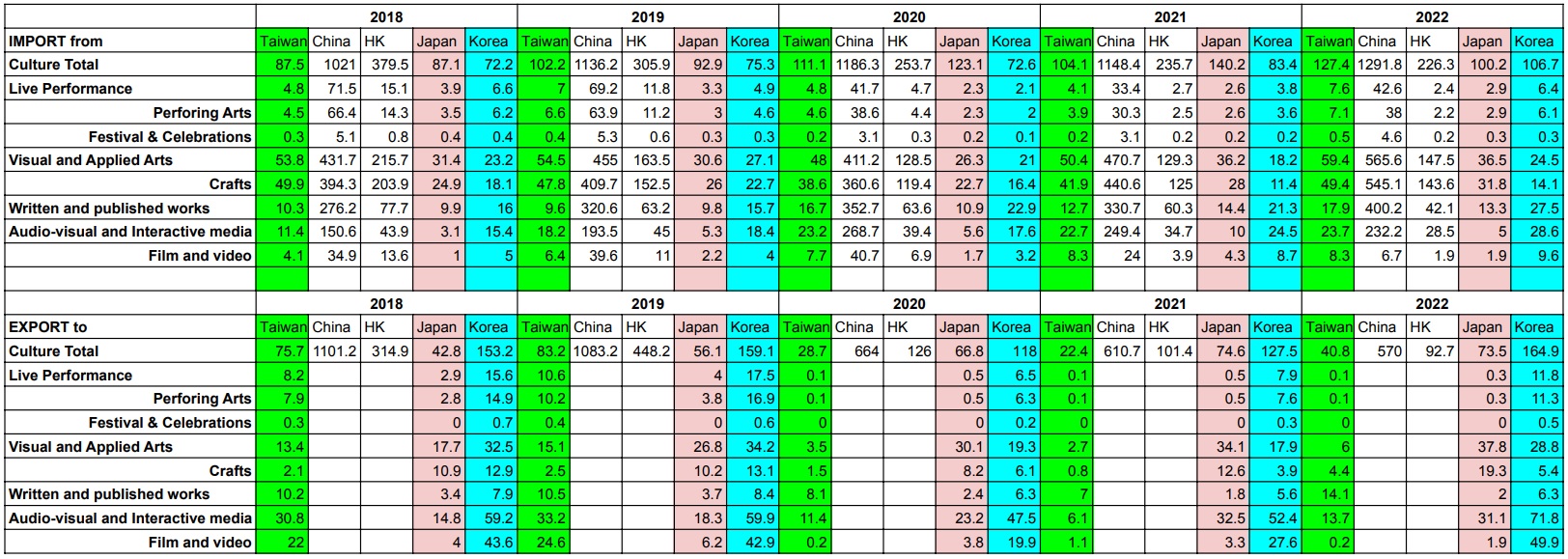
Cultural imports from Taiwan topped Japan and Korea
Similarly, the cultural-trade numbers deteriorated with Hong Kong over the same period, going from a $64.6-million deficit in 2018 to a $133.6-million deficit in 2022.
There was improvement with Japan. Canada’s cultural trade deficit of $44.3 million with Japan in 2018 shrank to a $26.7-million deficit in 2022.
South Korea was the outlier. Despite flooding the world with TV shows and K-pop, South Korea maintained a cultural trade deficit with Canada every year from 2018 to 2022. That deficit shrank from $81 million in 2018 to $58.2 million in 2022.
Here’s a surprise from the chart: cultural imports from Taiwan exceeded those from both Japan and South Korea in 2022. Moreover, Canadian cultural exports to Taiwan were significantly lower than Canadian cultural exports to both Japan and South Korea in 2022.
Last year, Canada imported $9.5 billion in merchandise from Taiwan, according to the federal government website. There were $2.6 billion worth of Canadian merchandise exports to Taiwan, accounting for a $6.9-billion merchandise-trade deficit. Canada also had a $650-million trade deficit in services with Taiwan in 2023.
Canada operates the Canadian Trade Office in Taipei, which is a locally incorporated entity. But Canada has no diplomatic relations with Taiwan due to Canada’s One China policy.
Last December, the Canadian Trade Office in Taipei and the Taipei Economic and Cultural Office in Ottawa signed an “arrangement” over foreign investment promotion and protection. Then in April, the two offices signed another “arrangement”, this time concerning science, technology, and innovation arrangement.
“This Arrangement will enable opportunities for business-led co-innovation partnerships in high tech sectors under the Canadian International Innovation Program as well as expanded research collaborations across the Canadian and Taiwanese ecosystems,” the Canadian government website states.
Follow the Toronto Spark on X @TOSparkOfficial. Follow Charlie Smith on Bluesky @charliesmithvcr.bsky.social.