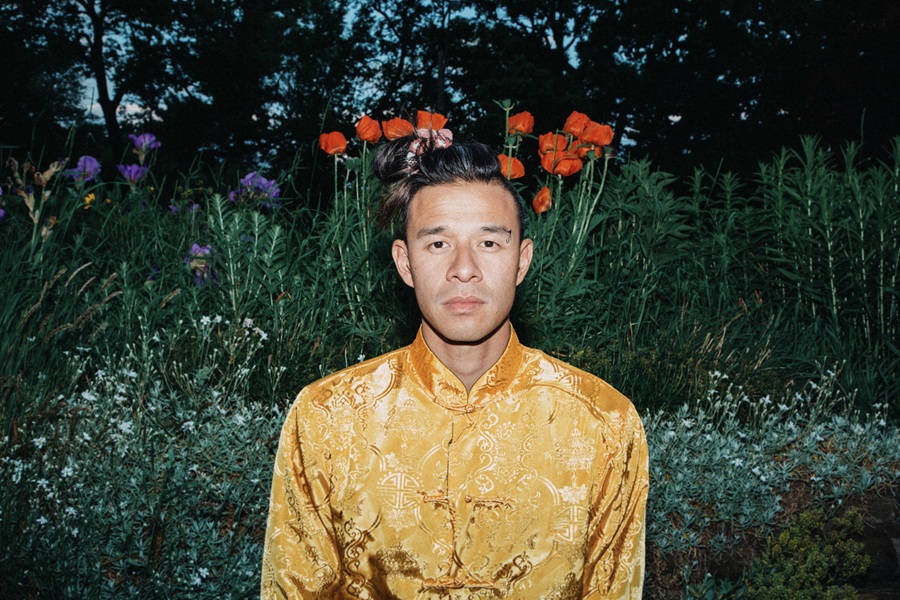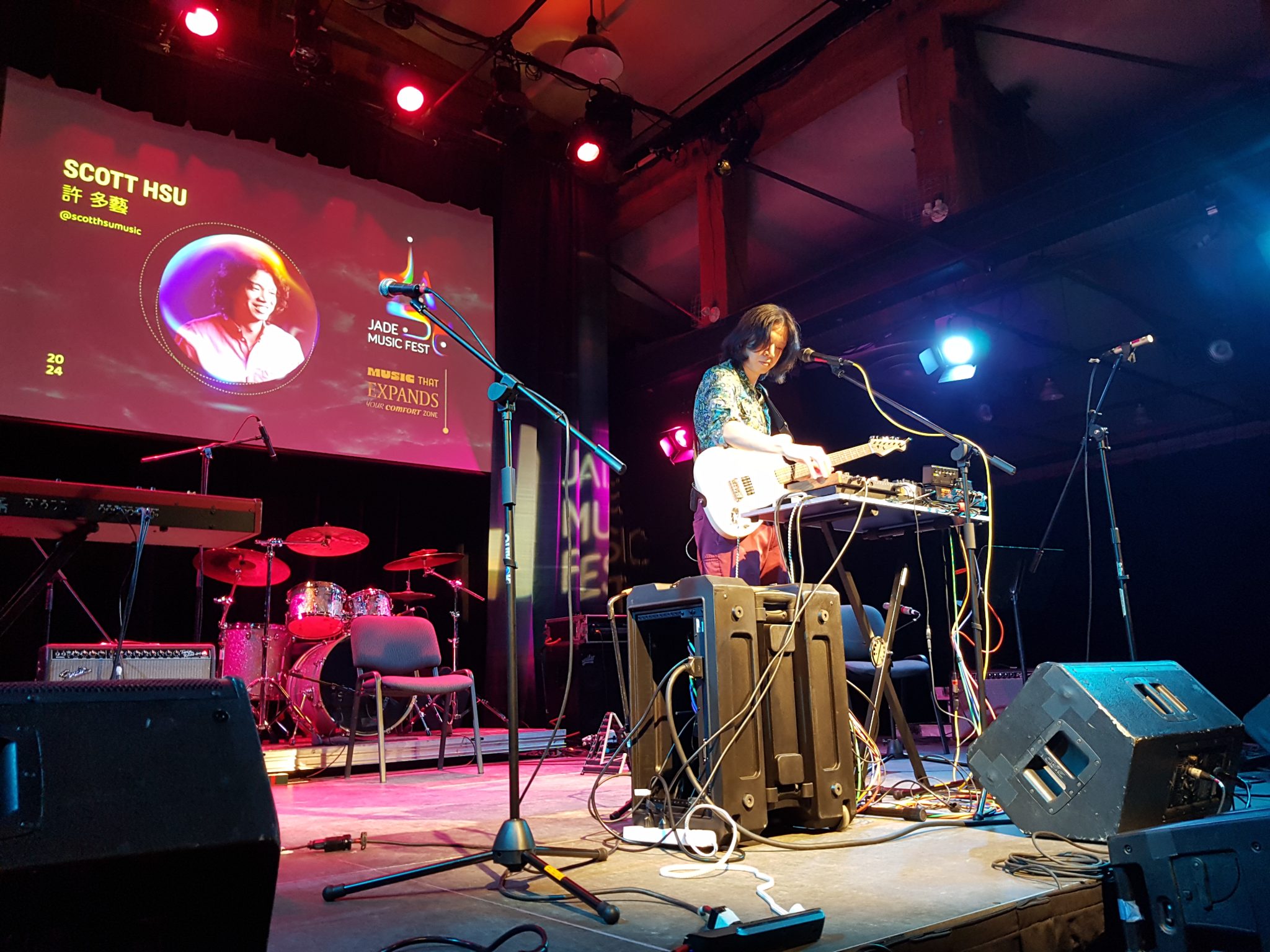
When solo musician Scott Hsu performed the first set at a recent Jade Music Fest showcase in Vancouver, he did a few things reflecting the spirit of the event. First off, the Massachusetts-based artist opened with an original song— “You Got My Love”—with Vancouver’s Alex See singing vocal harmony. Hsu looped in tracks from other instruments along with some his own voice distortions, giving his Pop Americana number a space-age feel.
Next came another original song, “Home” in which the Taiwanese American multi-instrumentalist wrote about finding his place in the world. Hsu’s baritone voice stood out amid more looping in this country-ish composition.
But then, Hsu did something unusual—he debuted a rockin’ song in Mandarin. He told the crowd that all of his previous songwriting had been in English, but now he was reconnecting with his heritage.
Hsu closed his set with a powerful rendition of Coldplay’s “Yellow”, passionately belting out most of the lyrics in Mandarin. It clearly resonated with many bilingual Mandarin-English speakers in the crowd, as well as with those who don’t speak Mandarin. Moments after Hsu finished, the emcee, Greta Lin, summed it up this way: “It moved me to tears, honestly.”
Earlier that day, Hsu spoke to Pancouver at Performance Works about his life and career choices. What he said helps contextualize what led up to those memorable moments at this venue on Granville Island.
Hsu’s story started with his parents immigrating to the U.S. in the 1980s from northern Taiwan.
“My dad was studying environmental engineering but he eventually decided to start his own business selling tropical fish, which was his childhood hobby,” Hsu said.
His mother helped out with the business and Hsu and his sister were born in America. They moved to Amherst, Massachusetts when Hsu was very young. It’s a college town—home to a large University of Massachusetts campus—with a population of about 40,000.
Hsu learns to play Asian instruments
At the age of seven, Hsu started taking piano lessons; he picked up the bass guitar when he was 14.
“I grew up on the rock tradition, so guitars and drums are a big part of what I do,” he said. “I’ve also been blending in a lot of electronic elements, like keyboards and synths.”
Hsu also incorporates folk elements into his music, a carryover from performing in church bands. Thus, he’s comfortable playing the banjo and mandolin. Moreover, he’s been playing the erhu, a two-stringed instrument often referred to as a Chinese violin.
“I also have a pipa,” Hsu says, referring to another Chinese instrument. “I’m still learning to play it.”
The pipa resembles a guitar. However, a performer plucks on the strings rather than strumming them.
“I’ve been exploring these different kinds of sounds and timbres that I can blend into the music that I do.”
Through looping, Hsu can play recorded tracks of a variety of instruments while he’s singing and playing guitar.
“Live looping on stage is a very different beast compared to doing it in studio,” he emphasized.
During the pandemic, Hsu started using looping tracks when he would stream music on Twitch because he couldn’t play live.
From teaching to music
Hsu took a circuitous journey to becoming a professional musician. In his formative years, he had a deep passion for music, but he didn’t think that he could have a career in the industry.
“That was because I just didn’t see anybody who looked like me doing what I was doing,” Hsu noted.
This discouraged him from believing in himself. As a result, he chose a more conventional career: education.
Hsu graduated from the University of Massachusetts and worked as a high school math teacher for 15 years. He taught overseas for a while at the American embassy school in New Delhi and in Ho Chi Minh City in Vietnam, as well as in American schools. And he loved doing this.
“It was definitely a very fulfilling experience for me,” Hsu said.
However, once COVID struck, he was having thoughts about his own mortality and realized that he was most energized making music.
“I wasn’t living my life to the fullest by not going all in on this passion of mine.”
Next week, Hsu will release a five-song album called Cliffs, which is a re-release of a disc he made a couple of years ago. He has re-produced all of his original songs.
“It really means a lot that people are doing interviews with me and people are giving me the chance to perform,” Hsu said. “Growing up, I very much was on my own. It was oftentimes very discouraging because I found it was very hard for me to be taken seriously.
“I had to be somebody else for people to kind of pay attention to me,” he continued. “I’m discovering at this stage of my artist trajectory, I should have been more authentic to myself all along. That’s really what I should have been doing.”
The Jade Music Fest gives musicians an opportunity to embrace heritage Chinese languages through live performances. Follow Scott Hsu on Instagram @scotthsumusic. Follow the Toronto Spark on X @TOSparkOfficial, and follow Charlie Smith @charliesmithvcr.bluesky.social.