In the middle of Pacific Mall, there’s a stage that almost nobody looks at. It sits in the Centre Court under the dome, at the one point where the dense grid of tiny shops finally opens up. Readers of the last essay might remember this spot: the white space at the centre of the street map, the one piece of floor that belongs to no one’s box. On most days, it’s empty. People cut across it on their way somewhere else, while the shops around it carry on. The stage just stands there, framed like something you’re supposed to be watching.
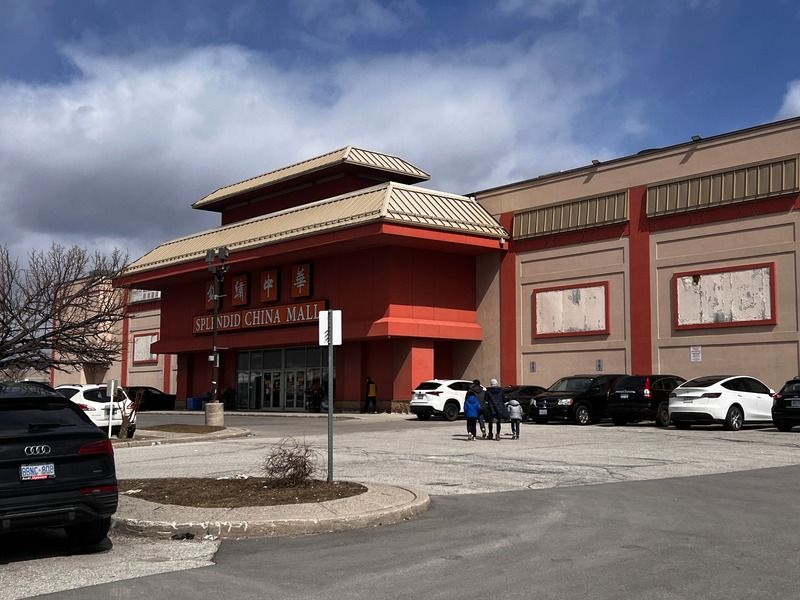
The empty stage draws more attention than the shops around it. Across Steeles at Splendid China stands another: big, formal, permanent, with nothing happening on it. A stage like that takes prime floor area, structure, and clear sightlines. Nobody builds all of that as a backdrop.
So the real question isn’t what the stage is. It’s why someone once believed it deserved this much of the building.

The answer begins next door, at Market Village, a mall that no longer exists. Opened in 1990 as a rural-themed market, it soon turned toward the Chinese Canadian families settling in Markham. As its outdoor walkways were roofed over in stages, a central gazebo stage ended up inside, at the heart of the food court. Through the 1990s, the community knew it as the place to see famous singers and actors from Asia in person. Before streaming, seeing a Hong Kong star meant being in the same room, and this was that room.
The stage was never decorated. It was one of the reasons to make the trip. Market Village closed in 2018, and its stage went with it.

Every conventional mall is organized around its anchors: a department store at each end, a corridor between them, everyone else along the way. It’s a linear plan, with the strongest pull placed at the edges.
Pacific Mall has no department store at either end. What it does have, right in the middle of everything, is a stage.
What if that was the anchor?
A department store pulls people to the ends. A stage does the opposite. It pulls people toward the centre, and the shops around it catch the crowd as it gathers and disperses. It’s placed where everything meets.
Mainstream malls have used stages too: in 1987, the teenage Tiffany sang her way through American malls to a number-one album. At Market Village, people came to see stars they already knew from Hong Kong film and music.
A department store anchors shoppers. A stage anchors a public, the segment of people who understand what’s being sung.

The Secular Temple Square
Understanding what kind of public means looking elsewhere. In Kowloon, Temple Street is named for the Tin Hau temple in Yau Ma Tei, whose banyan-shaded forecourt slowly became a night market of hawkers, fortune tellers and singers. A few singing stalls remain.
What stands out isn’t its history so much as its order. The temple comes first, then the open ground, then the crowd, then the market that grows around it. In Taiwan, a god’s birthday follows the same sequence: an opera or puppet show in the temple forecourt, then people, then vendors.
This isn’t to claim that the Chinese mall descends from the temple square. But the spatial mechanism is remarkably close. In the mall, the occasion is secular, and language helps draw the audience: a Cantonese ballad gathers one crowd, a Mandarin one another. For the length of a show, people scattered across the suburbs are in the same room. At Market Village, the gazebo stage remained at the centre as the walkways were roofed over.
Metro Square, built in 1997 with a Taiwanese community in mind, has no permanent stage at all, only open space set up when something is happening. People can still gather at the centre without a permanent stage.

The Chinese mall used the form of a square to do the work of an anchor. The stage gave people a reason to make the trip, gathered them at the centre, and let the market form around them.
But that mechanism belonged to a particular era. The department stores that anchored GTA malls have closed one after another, and fans now follow their idols on their phones. Pacific Mall’s stage still hosts holiday events and talent competitions, mostly for local performers. On Temple Street, the singing stalls have dwindled to a small cluster.
The stages remain, though the performances and audiences have changed.

Across Steeles, Splendid China is a much smaller mall, but its stage is anything but modest. It rises nearly two storeys beneath a skylight: warm wood panels, a lighting truss, speakers on either side, a wide flight of steps, balconies looking straight down. Everything about it was built for an audience.
On one recent afternoon, red ropes hung at the foot of the steps and the big video wall was dark. On the screen below it, CP24 was playing: a hockey score, a pizza ad, the weather, and a ticker announcing no subway service on Line 2 between Kipling and Jane. A few men sat in front of it, looking at their phones.
On a stage built for an audience, CP24 kept playing while the men in front of it looked at their phones.

Further Reading
“A guide to Metro Square in Markham,” blogTO (online article)
https://www.blogto.com/eat_drink/2012/05/a_guide_to_metro_square_in_markham/
“Market Village 城市廣場: End of an Era”, Matthew Lee. Fête Chinoise, September 15, 2020.
https://www.fetechinoise.ca/blog/community-market-village
“Heritage Appraisal of Tin Hau Temple and the adjoining buildings, Yau Ma Tei, Kowloon”, Antiquities and Monuments Office. Legislative Council Brief (Annex B), Development Bureau, Hong Kong SAR Government, May 22, 2020.
https://www.legco.gov.hk/yr19-20/english/subleg/brief/2020ln092_brf.pdf


