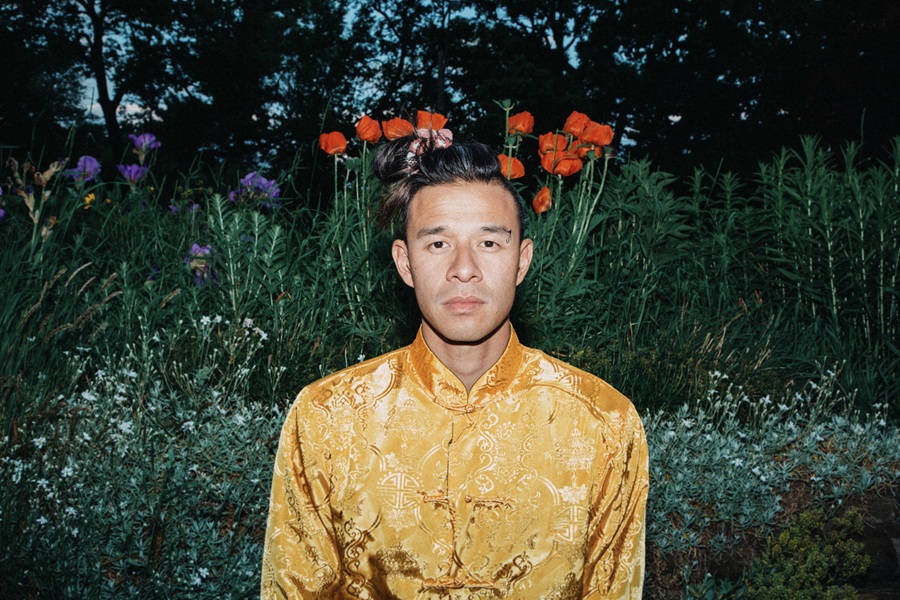
In recent years, Greg Ng has emerged as one of Vancouver’s most sought-after film and TV editors. With such credits as Longlegs, The Monkey, Bones of Crows: The Series, and The Grizzlie Truth, Ng’s work encompasses everything from horror and scripted television to documentary work. He also co-edited Saints and Warriors, which will be shown at this year’s Hot Docs Festival in Toronto and the DOXA Documentary Film Festival in Vancouver.
“I feel that when you can work in both doc and features, there is a lot you can bring to each of those things,” Ng tells the Toronto Spark over Zoom. “If we’re working on a horror movie, I can draw on my doc experience and be, like, ‘How can I make this feel as real as possible so that it’s not an illusion of something that’s scary.’
“Or, when I’m working on a documentary,” he continues, “I can be, like, ‘Well, how do I make this really scary or instill some kind of cinematic sense to this thing that’s otherwise quite plain?’ So, I feel pretty fortunate to have worked on all those things.”
Ng’s versatility is reflected in his Leo Awards for editing a motion picture (Sniper: Assassin’s End), short drama (The ABCs of Death), documentary (Wizard Mode), documentary series (Punk: Part 1), and short documentary (Finding Big Country). The latter film also captured the Canadian Cinema Editors Award.
This year, Ng is nominated with Maxime Lahaie and Roderick Deogrades for a 2025 Canadian Screen Award for Best Picture Editing, Drama for a TV series. It came for an episode of Bones of Crows: The Series, which is about a Cree code talker, Aline Spears, who survived Canada’s residential school system.
Watch the trailer for Bones of Crows: The Series.
Ng edits films by Osgood Perkins
Vancouver Métis/Dene filmmaker Marie Clements wrote and directed Bones of Crows: The Series, which is up for 12 Canadian Screen Awards. Clements also wrote and directed the 2022 film of the same name.
“That’s a very important story that needs to be told,” Ng says. “She is a great director.”
Ng maintains that his experience editing horror films helped him on Bones of Crows: The Series. Through horror, he mastered how to edit film in ways that add tension and fear.
This skill has attracted the attention of filmmaker and actor Osgood Perkins, who launched his career playing a young Norman Bates in Psycho II. Perkins, son of actor Tony Perkins, did some additional filming and reshoots in Vancouver for his 2020 film Gretel & Hansel. At the time, he worked with Chris Ferguson, producer of the Ng-edited 2013 vampire film Afflicted. When Perkins said that he wanted to make a psychological horror film in Vancouver, Ferguson recommended Ng and Graham Fortin as co-editors.
Longlegs, starring Maika Monroe as an FBI agent and Nicholas Cage in the title role, generated US$126.9 million in global box-office revenue. It was the top-grossing independent film released in 2024.
Perkins tapped Ng and Fortin to co-edit his next film, The Monkey, which is based on a Stephen King short story. With Perkins, the editors have explored a concept that Ng describes as “horror comedy”.
“This is a strange genre where you’re walking on the edge of the knife,” Ng explains. “We’re building tension in such a way that it follows the tropes of a horror movie. But then, instead of a scare, there’s a hilarious outcome—a big laugh at the end.”
Watch the trailer for Longlegs, directed by Osgood Perkins.
Film odyssey began with Star Wars box set
Editing is often called the “invisible art”. That’s because viewers don’t think about editing if it’s done well.
“A great editor can make a great movie great,” Ng quips. “But you know, a bad editor will make a great movie bad.”
Ng says that his interest in film began when he received a VHS box set of Star Wars movies in elementary school. It included a behind-the-scenes documentary on the making of Star Wars, revealing details about costumes and models used on-set, as well as visual effects. Back then, he had a primitive animation program on his home computer. So he tried animating a little bit of Star Wars.
“They never actually talked about how they edited the movie,” Ng notes.
Later, his family purchased a video camera, enabling Ng to shoot film footage. But he wondered how he could assemble images in a coherent fashion.
Fortunately, Ng’s father went to Radio Shack and bought a mixer. This enabled Ng to edit VHS and lay down music behind it. That’s when Ng had an epiphany—he could now instill emotion into his videos with big soundtracks. He even used “The Imperial March (Darth Vader’s Theme)” from Star Wars to make add a grand touch to a home production.
Ng spent a lot of time learning music and in high school, he played in some bands. That’s when he discovered what was possible with Sonic Foundry music-editing software.
“You could record some loops into a microphone or plug your guitar into the computer, and it would spit out some wacky stuff,” he recalls. “Of course, if you edited it to hell, it would turn into something very different and psychedelic.”
Watch the trailer for the Greg Ng–edited The Grizzlie Truth.
Ng likens editing to composing music
After high school, Ng enrolled in the UBC film program, which coincided with the rise of digital video editing. The first version of Final Cut Pro was released in 1999 and it allowed Ng to create star wipes and split screens. In his university years, he and his friends made movies, which he enjoyed editing. After graduating in 2004, he landed a job in post-production at Brightlight Pictures and continued editing short films.
Ng points out that editing has something in common with composing music. In both fields, a person can influence people’s emotions. Moreover, editing occurs close to the end of the movie-making process.
“When you have all the ingredients laid out before you, you can take those things and you put them together,” Ng states.
He likes how every project is different. Editing Nathan Drillot and Jeff Petry’s Wizard Mode taught him about the nuances of pinball. Ng learned about the history of the Vancouver Grizzlies basketball team when he edited Kathleen Jayme’s The Grizzlie Truth and Finding Big Country.
“Kat’s passion for the team and the sport was so infectious,” he says. “She gifted me at the end of that project one of Big Country’s gigantic shoes. It’s size 14 or something.”
Ng realizes that a director might take seven years to write and complete a feature film. As an editor, he can be a part of the team without having to invest so much time in a single project.
“I feel like editing is an art,” Ng says, “but I don’t sign my name at the bottom of a painting.”
Greg Ng edited Saints and Warriors, which will be screened at Hot Docs.