Brilliant statues come from the hands, tools, and imaginations of incredibly talented sculptors. But over the centuries, sculptors’ works have also been greatly influenced by the times that they were living. That point is driven home forcefully in the illuminating 2025 Taiwanese artistic documentary, Daughter of Nectar 甘露水.
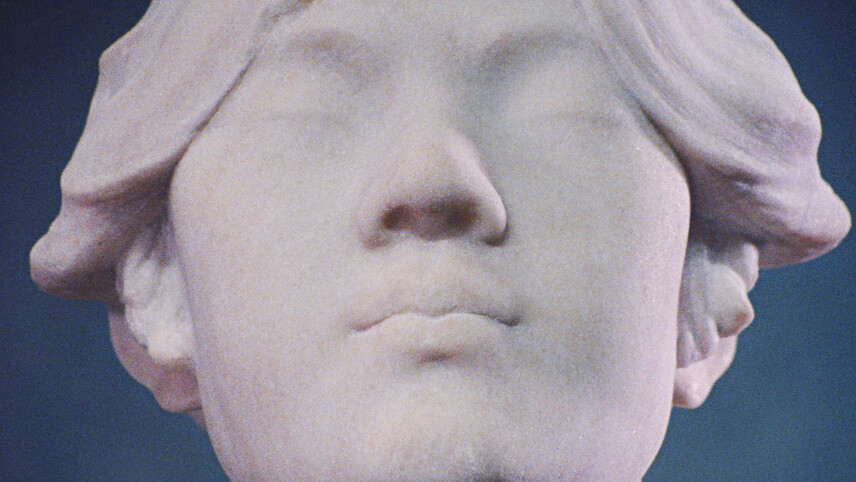
Co-directed by Huang Pang-Chuan and Lin Chunni, the 140-minute film re-imagines the circumstances in which Taiwanese sculptor Huang Tu-shui 黃土水 created his famous nude statue, Water of Immortality (甘露水). In 1921, this life-size sculpture standing in a shell was selected for Tokyo’s prestigious Imperial Art Exhibition. That was back when Taiwan was still a colony of Japan.
Over the next century, Water of Immortality followed a circuitous path, mirroring the vicissitudes of modern Taiwanese history. After 47 years in storage, it re-emerged in 2021 in dramatic fashion. In 2022, Water of Immortality became part of the permanent collection of the National Taiwan Museum of Fine Arts in Taichung.
The Society of We Are Canadians Too will present the Canadian premiere of Daughter of Nectar 甘露水 at 7 p.m. on Tuesday (October 27) in Vancouver.
“Shot on tactile 16mm, deeply rhythmic in construction, and accented by subtle in-camera effects, Daughter of Nectar is intimate and grand,” stated the Museum of Modern Art prior to its North American premiere in February in Midtown Manhattan.
Daughter of Nectar 甘露水 boldly tells the statue’s history in creative ways. To cite one example, the co-directors selected 16mm celluloid. The subtractive process of exposing this stock symbolizes the sculptor’s subtractive chiselling and carving of marble to expose Water of Immortality.

Nectar at heart of Buddhist folk tale
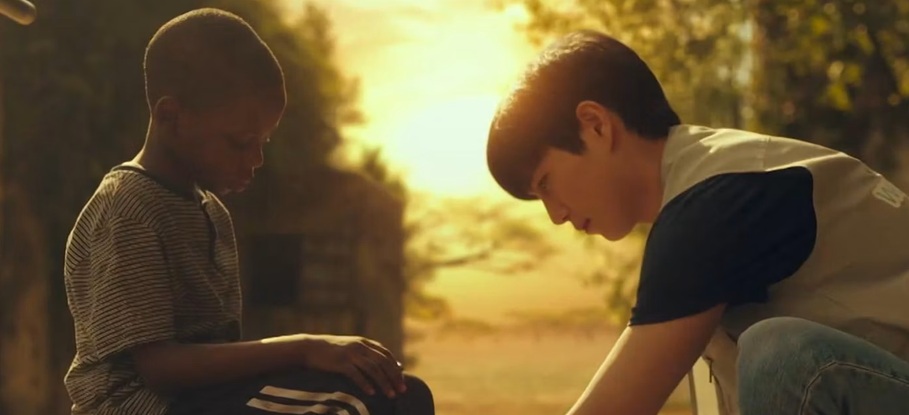
The film opens with an illustrated Japanese folk tale about a maiden of Bodhisattva Avalokitesvara. In “The Story of a Clam”, a poor young fisherman, Shiraza, catches a very special clam that grows larger and larger on his boat. Suddenly, it bursts open, freeing a beautiful young woman who goes to live with Shiraza.
Shiraza eventually finds himself at the bodhisattva’s castle, where the fisherman drinks the wine of seven virtues. It tastes of nectar and, magically, grants him 7,000 years of life.
It’s worth noting that Huang Tu-shui grew up surrounded by Buddhist imagery near the Zushi Temple in Mengjia (a.k.a. Monga and now present-day Wanhua District in Taipei). In Buddhist art, nectar represents immortality, divine wisdom, and the master’s healing compassion.
Following this introduction, the co-directors share the origins and life path of the statue over four chapters, each represented by a different-coloured sun.
It’s important to understand the historical context. Taiwan came under Japanese control in 1895 following the first Sino-Japanese War. Just over a month after Japanese forces landed in the northern port city of Keelung that year, Huang Tu-shui was born 30 kilometres to the south.
Thus, he may have believed as a child that he was Japanese and he grew up learning Japanese in school. But after moving to Japan, he quickly realized he was different and began thinking more about his Taiwanese identity.
The chapter entitled “Red Sun” focuses on how Huang Tu-shui developed his stone-carving practice in his student dormitory as the first Taiwanese art student in Japan. In 1915, he was admitted to the Tokyo Fine Arts School on a scholarship. The film details his journey from Taiwan and show sculptural templates that the master practised on.
Watch the trailer (above) for Daughter of Nectar 甘露水.
Historical photos integrated with modern-day footage
One historical photo reveals the location of the school in relation to the built environment. It reveals that Huang Tu-shui’s artistic education corresponded with growing use of electricity in Tokyo.
Another photo demonstrates how the school’s sculptural education was expanding at that time from a focus on wood and traditional Buddha statues to include plaster nudes. This coincided with growing liberalization in Japan during the Taisho Democracy period (1905-1932).
The co-directors deftly integrate historical photos with modern-day footage of Japanese sculpture students at his alma mater. This unusual approach conveys what day-to-day life felt like for Huang Tu-shui as a student in Tokyo.
Later in the documentary, the filmmakers juxtapose the contemporary and the past in another innovative way. Japanese Gothic Lolita musician SION walks into a wooded area to the ruins of a student dormitory. The frame of the building still exists after being rendered uninhabitable by a huge fire. She strolls through the burnt-out structure, pointing to its heavily damaged appliances, musical instruments, and furniture.
As SION reaches the third floor, she looks upward to the sky where a roof previously existed. More than 100 years ago, dorm residents would have heard the sounds of Huang Tu-shui sculpting Water of Immortality in the courtyard. SION contributes a song to the film, “Cinderella”, demonstrating once again that this is no ordinary documentary.
SION contributed music to the film.
Daughter of Nectar cites artistic influences
In the “Green Sun” chapter that follows, the co-directors offer insights into why Huang Tu-shui chose to marry western concepts of beauty with Asian spiritual beliefs in Water of Immortality.
His woodcarving teacher was Koun Takamura. And Huang Tu-shui learned how to carve marble from Italian artist Ottilio Pesci, who lived in Japan from 1912 to 1923. The Taiwanese art student had other Japanese teachers who studied under French sculptor Auguste Rodin.
Water of Immortality is most definitely Asian—the woman is Asian, the creator was Taiwanese, and it reflects a Buddhist story with the woman appearing to emerge from a clam. Yet it’s also European in shape, material, and form.
In fact, Water of Immortality embodies the growing international mindset and cultural awakening of Taiwanese artists in the early 1920s. The same year that the statue was unveiled, Chiang We-shui, Lin Hsieng-tang, and others launched the National Cultural Association of Taiwan.
“My diagnosis is that Taiwanese people suffer from intellectual malnutrition, which cannot be cured unless they take intellectual nourishment,” Chiang stated at the time. “A cultural movement is the only cure for this illness, and the Cultural Association is the institution specifically dedicated to researching and implementing this treatment.”
The association marked a key turning point in the rise of a uniquely Taiwanese identity. Often when outsiders speak of Taiwan, they refer to the economy or politics while overlooking the central role of artists in shaping the country’s destiny.

Every fine detail is carved
In Daughter of Nectar 甘露水, the camera pans up the back of a model and then up the back of the statue in Water of Immortality to the hair. As these close-up images appear, a Japanese art historian marvels over how Huang Tu-shui carved by hand with such precision, strike after strike. The scholar points out that even the belly button is highly detailed.
“He successfully captured Asian body proportions,” he states. “Muscles are excellently portrayed.”
He then mentions that Huang Tu-shui wanted to merge the beauty of the marble with the beauty of the human body.
“The work conveys this feeling,” the scholar continues. “From these handmade traces, every fine detail is carved. He must have used very fine chisels. These delicate lines are carved with great precision—even the creases on the nails are shown.”
It’s a magnificent work of art. But Water of Immortality did not receive the respect that it deserved from the Nationalist government after the end of the Second World War. This coincides with the start of the film’s “Black Sun” chapter, which addresses the transition to martial law in Taiwan.
Following the Second World War, Allied General Order No. 1 authorized the Republic of China’s Nationalist armed forces under Chiang Kai-shek to accept Japan’s surrender in Taiwan. Later in 1945, the Nationalists took over administrative control of Taiwan. They pillaged whatever they could to finance their ongoing civil war on the mainland against the Communists.
After the Nationalists lost the Chinese Civil War in 1949, Chiang moved his Kuomintang government to Taipei and ruled with an iron fist. In what become known as the White Terror era, Chiang’s regime tried to erase the Japanese cultural and linguistic footprint on Taiwan. Public officials disdained works of art linked to Japanese rule, such as Water of Immortality.
It was big news in Taiwan when the statue re-emerged in 2021.
Statue rescued by Taiwanese surgeon
In 1958, the Kuomintang government moved the Taiwan Provincial Consultative Council to Taichung, along with the statue. However, Water of Immortality ended up being abandoned and vandalized outside a Taichung train station.
How it was preserved forms the bulk of the rest of the film.
A Taiwanese writer and revolutionary, Zhang Shenqie, had been in the same dormitory as Huang Tu-shui. And Zhang understood the importance of the sculpture, so he contacted his younnger brother, a surgeon in Taichung named Dr. Zhang Hongbiao. The surgeon asked his wife to go to the train station to retrieve Water of Immortality. And it remained on display in their home, almost like a member of the family, until it was put in storage in the 1970s.
Zhang Shenqie’s memoir, Black Sun, describes the defeat of Japan in the war, his expectations for the Nationalist government, and his subsequent deep disappointment. A leading figure in the New Taiwan Literature Movement during the Japanese colonial era, he went into hiding to avoid being arrested by the Kuomintang government.
His ideas influenced his younger brother, who didn’t want Nationalist authorities to seize and possibly destroy the statue.
The fourth “White Sun” chapter focuses how the statue survived the White Terror, which lasted for decades. It features the surgeon’s children explaining why they felt that the time had finally come to bring Water for Immortality back into public view.
Some of the film’s most moving moments come when Taiwanese actor Hsu Hsiao-shun recites a section Huang’s article, “Born in Taiwan”, which was published in 1922. More than a century after these words were written, they continue to inspire artists across Taiwan:
By moulding the dark soil of the fields,
a child’s innocence is brought to life.
By carving a block of red wood,
a man of true spirit comes alive.
By shaping a white stone into a graceful woman,
they will never age, never die—
humans with eternal life.
This joy of creation is beyond others’ imagination.
Young folks from my homeland,
join me on the path of art,
where flowers bloom ceaselessly, birds sing without end.
Let’s go together!
The Toronto Spark is on Bluesky @torontospark.bsky.social.