
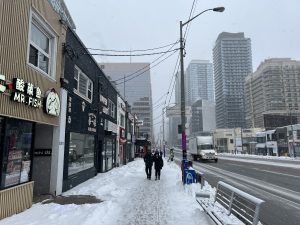
When first settling in Canada, life was centered near North York Centre. With its dense clusters of Chinese and Korean signage, its 1980s and 1990s high-rises, and the constant hum of a transit hub, the area often produced a quiet sense of displacement. It didn’t feel like a North American suburb; it felt closer to a bustling East Asian metropolis.
This “generic city centre” did not happen by accident. Unlike Old Toronto, which grew organically from its harbor and marketplaces, North York’s downtown was deliberately made. It is one of the rare cases in Toronto’s history where a city center was willed into existence from a collection of scattered settlements.
A Search for Identity
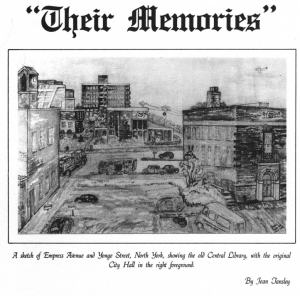
In 1922, North York was little more than the rural fringe of York Township. Feeling neglected by central administration, residents broke away to form their own municipality. At its birth, North York had no center: it consisted of mill villages, scattered houses at crossroads, and linear settlements stretched along Yonge Street.
The real transformation began after the Second World War. In 1967, North York became a borough and joined Metropolitan Toronto. Capital and population flowed in rapidly. Yorkdale Shopping Centre opened in 1964, and York University established its Steeles and Keele campus a year later. Yet despite this growth, planners faced a persistent problem: North York was a bedroom community. People lived there, but worked and socialized elsewhere.
Manufacturing a Downtown
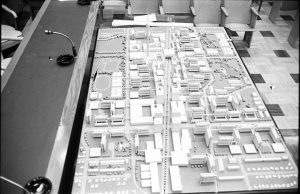
As early as 1963, planners proposed a bold response: the Civic Centre Redevelopment. The goal was to build a civic heart from scratch along Yonge Street around Willowdale. The plan envisioned a two-mile urban axis from Sheppard to Finch, clustering civic buildings, public institutions, and high-density housing into a single, legible center.
This was also a calculated bet on transit. As the Bloor–Danforth subway line was completed, planners were already anticipating the northward extension of the Yonge line as the backbone of this new sub-center.
The Amalgamation Heartbreak
That manufactured heart did not remain independent for long. In 1998, the Ontario provincial government, under Premier Mike Harris, pushed through the megacity amalgamation.
Framed around “efficiency” and “cost-saving,” North York, along with five other municipalities, was dissolved into the new City of Toronto. Local opposition was strong. In a 1997 non-binding referendum, nearly three-quarters of voters opposed the merger.
The “Ontario” Reality
The province proceeded regardless. Local governments were disbanded, and North York’s carefully constructed civic identity was absorbed into a much larger municipal framework.
In Ontario, a city’s center is ultimately shaped by provincial authority. North York’s downtown was formed by planners and later overridden by politics—leaving behind a dense, transit-oriented, neon-lit landscape that still feels slightly, and tellingly, out of place.
—
Further Reading
Unbuilt Toronto: A History of the City That Might Have Been – David Boyle. Toronto: Dundurn Press, 2014
“Progress, Economy, Heart: Celebrating 100 Years of North York,” City of Toronto (online exhibit)
https://www.toronto.ca/explore-enjoy/history-art-culture/online-exhibits/web-exhibits/web-exhibits-community-neighbourhoods/progress-economy-heart-celebrating-100-years-of-north-york/
“Timeline of North York,” North York Historical Society (online resource),
https://nyhs.ca/resources/timeline-of-north-york/


